Every Trip to the Grocery Store Is a Money Lesson in Disguise

Nobody sits their eight-year-old down and says, "Today we're going to talk about opportunity cost." But hand that same kid a $20 bill at the grocery store and ask them to figure out dinner for four? Suddenly, they're doing the math.
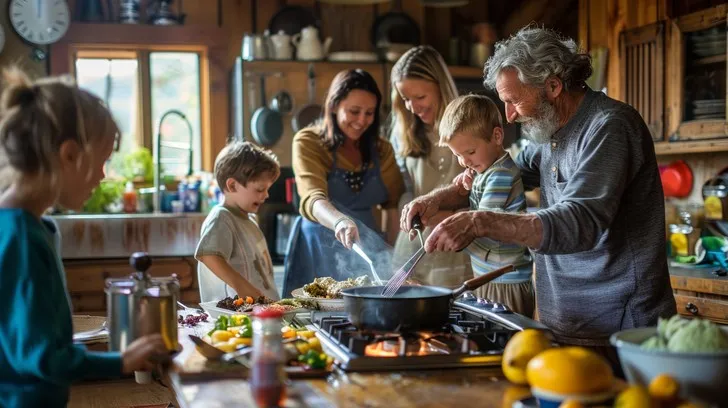
This is one of the most underrated things that happens in families who cook together. The kitchen—and everything that leads up to it—is quietly, consistently teaching children how money actually works. Not in the abstract way schools sometimes try to explain it, but in a deeply real, stomach-rumbling, this is what we can afford for the week kind of way.
If you've been looking for a way to raise financially savvy kids without making it feel like homework, you might already be doing it. You just haven't noticed yet.
The Budget Conversation You're Already Having
Every time you glance at the weekly circular before you head to the store, you're making a financial decision. Every time you swap chicken thighs for chicken breasts because one's on sale, you're comparison shopping. These are real-world money skills—and when your kids are standing next to you while you do them, they're absorbing every bit of it.
The trick is to let them in on the thinking out loud. Instead of silently choosing the store-brand pasta sauce, say something like, "This one's $1.89 and this one's $3.50—they're basically the same thing, so we're going with this one." That one sentence does more for your child's financial intuition than a lot of formal lessons ever could.
You don't have to turn every shopping trip into a classroom. Just narrate a little. Let them see the decision-making process happening in real time.
Let Them Hold the List—and the Budget
Once your kids are old enough to read and do basic addition, try handing them the grocery list. Tell them you've got a set amount to spend—say, $60 for the week's dinners—and see how they engage with the problem.
This works especially well when you loop them into the meal planning beforehand. If your ten-year-old helped choose Tuesday's taco night and Sunday's pasta bake, they've got skin in the game. They want to make sure the budget stretches far enough to cover both.
Watch what happens when they realize that the fancy shredded cheese costs twice as much as the block they could grate themselves. Or that buying a whole rotisserie chicken and pulling it apart for two different meals is a better deal than buying pre-cut chicken strips. These are the kinds of realizations that stick with a person for decades.
Unit Pricing: The Superpower Nobody Talks About
Here's a skill that a surprising number of adults never fully develop: reading the unit price on a grocery shelf tag. That tiny number—cost per ounce, cost per count—is one of the most practical financial tools out there, and most kids have never been shown how to use it.
Next time you're in the cereal aisle or standing in front of a wall of olive oil, point it out. Show your kid that the bigger container isn't always the better deal, and sometimes it is. Let them compare two options using the unit price and make the call. It takes about thirty seconds, and it's the kind of habit that will quietly save them hundreds of dollars a year as adults.
Meal Planning as a Budgeting Exercise
Sunday meal planning doesn't just save you stress during the week—it's also a surprisingly solid intro to budgeting concepts like allocation, prioritization, and trade-offs.
When you sit down with your kids to figure out what you're eating this week, you're essentially building a small financial plan. You've got limited resources (money, time, what's already in the fridge), and you have to make choices about how to use them. Some nights call for something a little more expensive. Other nights you use up what's about to go bad so nothing gets wasted.
That last part—reducing food waste—is a money conversation all on its own. When kids understand that throwing away wilted spinach is the same as throwing away the dollar and a half you paid for it, something shifts. Food stops being abstract and starts having real value attached to it.
The Connection Between Cooking and Financial Confidence
Research consistently shows that kids who are brought into household financial decisions early tend to develop stronger money management skills as they grow up. And while there are plenty of ways to do that, cooking is one of the most natural and low-pressure entry points.
There's no test. There's no grade. There's just dinner, and the process of figuring out how to make it happen within the constraints of real life. That's a pretty accurate preview of adult financial decision-making, honestly.
Kids who cook also develop a much clearer understanding of the cost difference between eating at home and eating out. When your teenager has helped make a big pot of soup from scratch and knows it cost about $8 to feed the whole family, they start to notice that the fast food run they wanted cost almost that much for one person. That awareness compounds over time.
Make It Feel Like Teamwork, Not a Lesson
The key to all of this is keeping it casual. The moment it starts to feel like a formal money lesson, most kids will check out. But when it's just part of how your family does things—"Hey, come help me figure out what we're making this week"—it feels like being included. And kids want to be included.
Give them real responsibility. Let them make small decisions that actually count. If they choose the more expensive option, talk through it without making it a big deal. If they find a great deal, celebrate it. "Nice catch, that saves us almost two bucks" is more effective than any lecture.
The kitchen has always been a place where families pass things down—recipes, stories, techniques, traditions. It turns out, it's also one of the best places to pass down a healthy relationship with money. You're just doing it one grocery run at a time.