Why the Best Family Talks Happen Over a Cutting Board
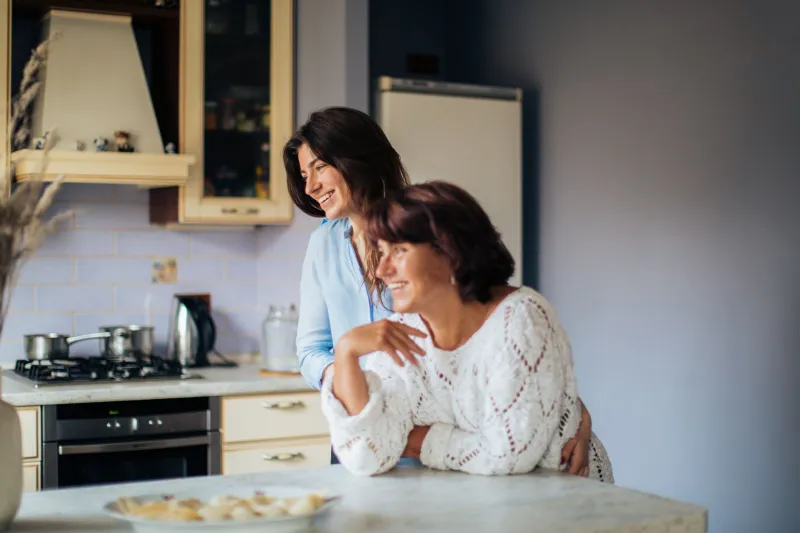
There's a conversation that happened in a kitchen in suburban Ohio that a woman named Renata still thinks about years later. She and her adult daughter hadn't been getting along — not in any dramatic, blow-up kind of way, but in that slow, quiet drift that families sometimes fall into without anyone meaning for it to happen. They'd tried talking over coffee. They'd tried texting. Nothing landed right.
Then one Sunday, they made pierogies together. Old family recipe, lots of steps, floury hands. Somewhere between folding the dough and pressing the edges shut, the conversation they'd been avoiding for two years just... started. No agenda. No eye contact required. Just two people doing something useful with their hands while the real work happened somewhere deeper.
"I don't know why it worked then and not before," Renata says. "But I think we both needed somewhere to look that wasn't each other."
She's not alone in that experience. Across American families, the kitchen keeps showing up as the unlikely setting for breakthroughs — the place where a teenager finally opens up, where siblings work through old grievances, where a parent and an adult child find their way back to each other. And it's not a coincidence.
The Psychology of Side-by-Side
There's actually a term for what Renata and her daughter stumbled into: parallel engagement. Psychologists who study communication have long noted that people — especially those who find direct emotional conversations stressful — tend to open up more easily when they're engaged in a shared physical task. The activity gives the brain something neutral to anchor to, which reduces the perceived threat of the conversation itself.
Think about how often meaningful talks happen in cars. You're not facing each other. There's something else going on. The kitchen operates on the same principle, but with even more going for it: you're creating something together, you're following a shared purpose, and the rhythm of the work — chopping, stirring, kneading — has a genuinely calming effect on the nervous system.
Cooking also has a built-in structure. There are steps to follow, things to check on, natural pauses. That pacing gives hard conversations room to breathe. You can say something heavy and then both of you can quietly focus on the onions for a minute without it feeling like an awkward silence. The kitchen absorbs the pause.
When Words Don't Come Easy
For families navigating tension — whether it's something fresh or something that's been sitting for years — the dinner table can actually feel like the worst place to talk. Everyone's facing each other. It's performative. There's pressure to resolve things before someone needs to clear the plates.
The kitchen removes that pressure almost entirely.
Marcus, a dad in Atlanta, describes how he finally got through to his teenage son after months of one-word answers and slammed doors. He didn't sit him down for a talk. He just asked him to help make chili — a recipe they used to make together when the kid was younger. "He started telling me about school stuff I hadn't heard in forever," Marcus says. "Not because I asked. Just because we were doing something together and it felt normal again."
That word — normal — comes up a lot when families describe these moments. The kitchen is a normalizing space. It's familiar, it's domestic, it's not loaded with the emotional staging that living rooms or therapists' offices can carry. When you're just two people making dinner, the hierarchy flattens a little. A parent becomes a collaborator. A sibling becomes a teammate.
The Ritual That Makes It Possible
What's interesting is that these conversations rarely happen on the first try. They tend to emerge from repeated kitchen time together — from a habit of cooking alongside each other that builds enough comfort for the harder stuff to surface naturally.
This is one of the most underrated arguments for making family cooking a regular practice. It's not just about the food. It's about the accumulated hours of low-stakes togetherness that create the conditions for high-stakes honesty.
Families who cook together regularly often describe a kind of shorthand that develops — not just about recipes, but about each other. You learn how someone moves when they're stressed. You notice when someone goes quiet. You get used to being in each other's space without it meaning anything loaded. And that familiarity is exactly what makes it safe enough to eventually say the thing you've been holding.
Starting Small When Things Feel Big
If your family is carrying some weight right now — distance, conflict, things left unsaid — you don't need to engineer a kitchen therapy session. That would defeat the whole point. What works is simply creating the opportunity and letting the space do its thing.
Pick something that takes a little time. Bread dough. A batch of tamales. Sunday gravy. Something with enough steps that you'll be in the kitchen together for an hour or more. Invite the person without framing it as a conversation — just frame it as cooking.
Don't go in with an agenda. The goal isn't to fix anything before the timer goes off. The goal is to be in the same room, doing something with your hands, being present without the pressure of being productive. Let the conversation find its own level.
And if it doesn't happen that day, make the same thing next week. These things rarely happen on demand. They happen in the accumulation.
What the Kitchen Already Knows
There's a reason so many family memories live in kitchens. It's not just nostalgia for the food. It's the feeling of being alongside someone — really alongside them, in the practical, unhurried, flour-dusted way that modern life rarely makes room for.
The kitchen has always been the room where families actually talked. Not the polished, seated, napkins-on-laps kind of talking. The real kind. The kind that happens when you're both a little distracted, when there's nowhere to be except right there, when the act of making something together quietly reminds you that you're still on the same side.
If there's someone in your family you've been circling around — a conversation you keep almost having, a distance that's grown without anyone quite deciding to let it — maybe you don't need a plan. Maybe you just need a recipe and a second set of hands.
The kitchen has a way of handling the rest.