Home Is Where the Recipe Is: How Families on the Move Keep Their Food Traditions Rooted
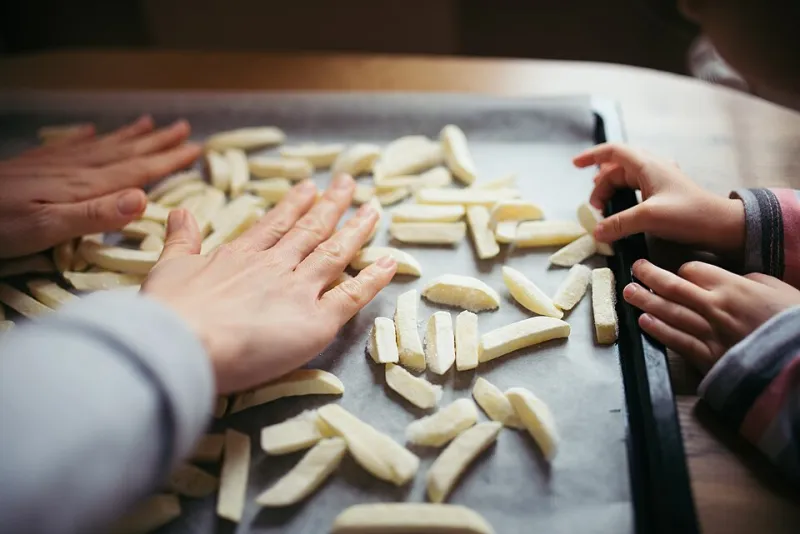
Photo: Shixart1985, CC BY 2.0, via Wikimedia Commons
By the time Renata Okafor's family had their fourth military relocation in six years — from North Carolina to Japan to Germany and finally to a base in Colorado — she'd stopped trying to recreate her Nigerian grandmother's pepper soup with the exact same ingredients. Instead, she'd started keeping what she calls her "swap list": a handwritten notebook tucked into her moving box that translates hard-to-find ingredients into local equivalents, wherever local happens to be.
"Food was the one constant," she says. "The furniture changed, the schools changed, the weather changed. But if I could get something close to that pepper soup on the stove, my kids knew we were going to be okay."
For families who move frequently — whether due to military service, international work assignments, or simply a life that keeps them on the road — food does something remarkable. It carries memory. It creates continuity across zip codes and time zones. And in the hands of parents who are intentional about it, cooking becomes one of the most powerful tools for helping children feel grounded when everything else is in flux.
The Emotional Weight of a Recipe
There's a reason military family support groups so often center around shared meals. Food isn't just nutrition — it's narrative. The dishes we grew up with are tied to specific people, specific kitchens, specific feelings of belonging. When you move away from those people and those kitchens, the recipes become a kind of portable home.
Psychologists who work with children through relocation transitions consistently point to routine and sensory familiarity as stabilizing forces. A meal that smells the same, tastes the same, and is prepared the same way as it always has been sends a powerful signal to a child's nervous system: we are still us, even here.
For expat families especially, this plays out in very specific ways. Parents report going to extraordinary lengths to source familiar ingredients — making special trips to international grocery stores, ordering spices online, or learning to make from scratch what they used to buy pre-made. It's not stubbornness. It's love in a practical form.
Adapting Without Losing the Thread
Of course, not every ingredient travels. And that's where the real creativity comes in.
Marcus and Jillian Tran, who've relocated four times with their three kids for Jillian's consulting work, developed what they call "the spirit of the dish" approach. "We ask ourselves: what makes this recipe this recipe? Is it the technique? The spice profile? The texture? Once you know that, you can make substitutions without losing what matters."
For their family's Vietnamese caramelized ginger chicken — a dish Jillian's mother has made for decades — the heart of the recipe is the caramelization and the ginger. When they landed in a small town in Tennessee where fish sauce was nowhere to be found, they worked through several substitutions before landing on a combination of soy sauce, a splash of lime, and a pinch of sugar. "It's not identical," Marcus admits. "But when the kids smell it cooking, they still say it smells like Grandma's house. That's what we were going for."
Keeping a flexible recipe journal — one that notes not just ingredients but the why behind each one — makes this kind of adaptation much easier. When you understand that a particular spice is there for warmth rather than heat, for example, you can find a substitute with confidence instead of guessing.
Smaller Kitchens, Bigger Creativity
One of the practical realities of frequent moves is that kitchens vary wildly. Military housing, short-term rentals, and apartments abroad often come with limited counter space, unfamiliar appliances, and minimal storage. For families used to a full kitchen setup, this can feel genuinely defeating — especially when you're trying to cook the elaborate recipes that feel like home.
A few strategies that experienced movers swear by:
Keep a "kitchen essentials" box that travels with you. This isn't about duplicating your whole kitchen. It's about the two or three tools that are genuinely irreplaceable to how you cook — your grandmother's wooden spoon, the specific knife you've used for fifteen years, a small mortar and pestle. Having familiar tools in an unfamiliar kitchen helps more than you'd think.
Simplify the dish, not the tradition. If your family's Thanksgiving stuffing normally requires a stand mixer and a 12-inch cast iron skillet you left in storage, find the stripped-down version. The tradition isn't the complexity — it's the act of making it together, every year, no matter where you are.
Let the new place add something. Some of the most beloved family recipes in relocating households are hybrids — dishes that started as something familiar but picked up an ingredient or technique from a new location. A Texas BBQ rub that made its way into a Southern family's pot roast after a posting in San Antonio. A Korean fermentation technique picked up during a year in Seoul that completely transformed a family's weeknight vegetables. These additions don't dilute a food tradition. They expand it.
Bringing Kids Into the Conversation
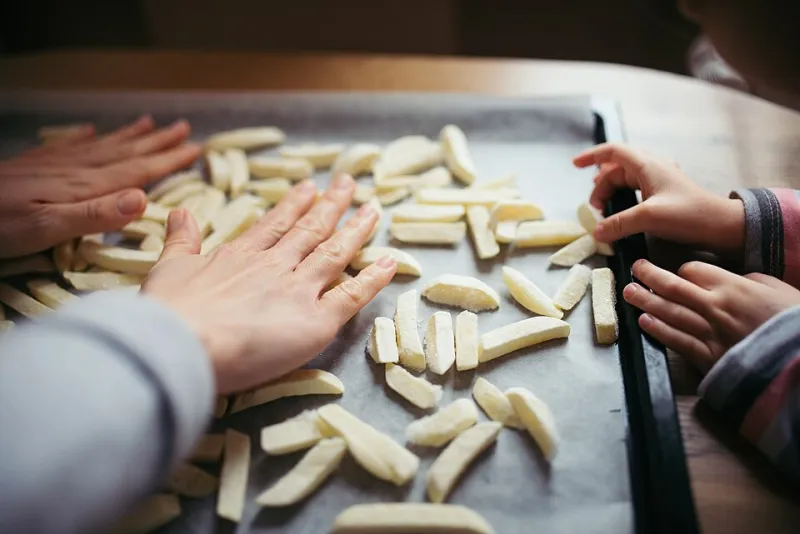
For children, frequent moves can feel disorienting in ways they don't always have words for. Cooking together gives them something concrete to hold onto — and a language for talking about where they come from.
Many parents who move often make a deliberate practice of cooking "home recipes" with their kids, narrating as they go. Not just the steps, but the stories. This is how your great-aunt taught me to fold these. We always made this on the first cold night of fall. Your dad proposed to me after eating this for the first time. These stories are the real inheritance being passed down — the recipe is just the vehicle.
Older kids can be given real ownership: the teenager who becomes the family's designated maker of a particular dish, the one who's in charge of sourcing the right ingredients in a new city. That kind of responsibility creates identity. It tells a child: you are the keeper of something important.
A Kitchen That Goes Where You Go
What families like Renata's and the Trans' have figured out is that a food tradition isn't really about a place. It's about intention. It's about deciding, over and over again, that this matters enough to carry forward — even when the carrying is inconvenient, even when the ingredients aren't quite right, even when the kitchen is tiny and the boxes are only half unpacked.
The address changes. The kitchen table might be different. But if the soup is on the stove and the family is gathered around it, you're already home.